Suppose Cr11 is the Vector Space of Continuous Realvalued Functions Show That U Perp 0
5 Vector Space 
In Section 2.2 we introduced the set  of all
  -tuples (called \textit{vectors}), and began our investigation of the matrix transformations
 given by matrix multiplication by an
  matrix. Particular attention was paid to the euclidean plane
  where certain simple geometric transformations were seen to be matrix transformations.
In this chapter we investigate in full generality, and introduce some of the most important concepts and methods in linear algebra. The -tuples in will continue to be denoted  ,
,  , and so on, and will be written as rows or columns depending on the context.
Subspaces of 
We say that the subset  is closed under addition if S2 holds, and that is closed under scalar multiplication if S3 holds.
Clearly is a subspace of itself, and this chapter is about these subspaces and their properties. The set  , consisting of only the zero vector, is also a subspace because
  and
and  for each
  in
in  ; it is called the zero subspace. Any subspace of other than
  or is called a proper subspace.
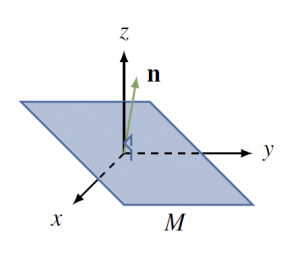 We saw in Section 4.2 that every plane
  through the origin in
  has equation
  where ,
  , and
, and  are not all zero. Here
 ![\vec{n} = \left[ \begin{array}{r} a \\ b \\ c \end{array} \right]](https://ecampusontario.pressbooks.pub/app/uploads/quicklatex/quicklatex.com-42934c8c6d7598bbbfabd2956acea6de_l3.png "Rendered by QuickLaTeX.com") is a normal for the plane and
is a normal for the plane and

where
![\vec{v} = \left[ \begin{array}{r} x \\ y \\ z \end{array} \right]](https://ecampusontario.pressbooks.pub/app/uploads/quicklatex/quicklatex.com-791876e73684794dc413de67ff982d5c_l3.png "Rendered by QuickLaTeX.com") and
and  denotes the dot product introduced in Section 2.2 (see the diagram). Then is a subspace of
  . Indeed we show that satisfies S1, S2, and S3 as follows:
S1.  because
  ;
;
S2. If  and
and  , then
  , so
, so  ;
;
S3. If , then  , so
, so  .
.
Planes and lines through the origin in  are all subspaces of .
Solution:
We proved the statement for planes above. If  is a line through the origin with direction vector
  , then
  . Can you verify that satisfies S1, S2, and S3?
Example 5.1.1 shows that lines through the origin in  are subspaces; in fact, they are the only proper subspaces of . Indeed, we will prove that lines and planes through the origin in are the only proper subspaces of . Thus the geometry of lines and planes through the origin is captured by the subspace concept. (Note that every line or plane is just a translation of one of these.)
Subspaces can also be used to describe important features of an matrix  . The null space of , denoted
  , and the image space of , denoted
  , are defined by

In the language of Chapter 2, consists of all solutions in  of the homogeneous system
  , and is the set of all vectors in
  such that
  has a solution . Note that is in if it satisfies the condition , while consists of vectors of the form
  for some in . These two ways to describe subsets occur frequently.
Solution:
- The zero vector
 lies in because
  . If and
  are in , then
  and
and  are in because they satisfy the required condition:
Hence
satisfies S1, S2, and S3, and so is a subspace of . - The zero vector
 lies in because
  . Suppose that and
  are in , say
  and
and  where and are in . Then
show that
 and
and  are both in (they have the required form). Hence is a subspace of .
There are other important subspaces associated with a matrix that clarify basic properties of . If is an  matrix and
  is any number, let

A vector is in  if and only if
  , so Example 5.1.2 gives:
is called the eigenspace of corresponding to . The reason for the name is that, in the terminology of Section 3.3, is an eigenvalue of if  . In this case the nonzero vectors in are called the eigenvectors of corresponding to .
The reader should not get the impression that every subset of is a subspace. For example:
![\begin{align*} U_1 &= \left \{ \left[ \begin{array}{l} x \\ y \end{array} \right] \, \middle| \, x \geq 0 \right\} \mbox{ satisfies S1 and S2, but not S3;} \\ U_2 &= \left \{ \left[ \begin{array}{l} x \\ y \end{array} \right] \, \middle| \, x^2 = y^2 \right\} \mbox{ satisfies S1 and S3, but not S2;} \end{align*}](https://ecampusontario.pressbooks.pub/app/uploads/quicklatex/quicklatex.com-3558b83af0b3ecb86543b5a0dcda7f04_l3.png "Rendered by QuickLaTeX.com")
Hence neither  nor
nor  is a subspace of
  .
.
Spanning sets
Let  and
and  be two nonzero, nonparallel vectors in with their tails at the origin. The plane through the origin containing these vectors is described in Section 4.2 by saying that
  is a normal for , and that consists of all vectors
  such that
  .
.
While this is a very useful way to look at planes, there is another approach that is at least as useful in and, more importantly, works for all subspaces of for any  .
.
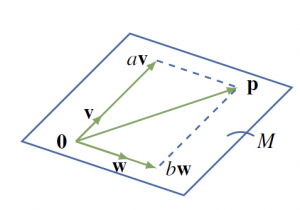 The idea is as follows: Observe that, by the diagram, a vector is in if and only if it has the form

for certain real numbers and (we say that is a linear combination of and ).
Hence we can describe as

and we say that  is a spanning set for . It is this notion of a spanning set that provides a way to describe all subspaces of .
As in Section 1.3, given vectors  in , a vector of the form

is called a linear combination of the  , and
, and  is called the coefficient of in the linear combination.
Here are two examples:

which we write as  for simplicity.

In particular, the above discussion shows that, if and are two nonzero, nonparallel vectors in , then

is the plane in containing and . Moreover, if is any nonzero vector in (or ), then

is the line with direction vector . Hence lines and planes can both be described in terms of spanning sets.
Solution:
The vector is in if and only if  for scalars
  and
and  . Equating components gives equations

This linear system has solution  and
and  , so is in . On the other hand, asking that
  leads to equations

and this system has no solution. So  does not lie in .
Proof:
- The zero vector
 is in because
  is a linear combination of the . If
  and
and  are in , then
  and are in because
Finally each
 is in (for example,
  ) so S1, S2, and S3 are satisfied for , proving (1).
 - Let where the are scalars and each
 . Then each
  because
  satisfies S3. But then
  because satisfies S2 (verify). This proves (2).
Condition (2) in Theorem 5.1.1 can be expressed by saying that  is the smallest subspace of that contains each . This is useful for showing that two subspaces and are equal, since this amounts to showing that both
  and
and  . Here is an example of how it is used.
Solution:
Since both and  are in
  , Theorem 5.1.1 gives

But  and
and  are both in
  , so
, so

again by Theorem 5.1.1. Thus  , as desired.
It turns out that many important subspaces are best described by giving a spanning set. Here are three examples, beginning with an important spanning set for itself. Column  of the identity matrix
  is denoted
  and called the th coordinate vector in , and the set
  is called the standard basis of . If
![\vec{x} = \left[ \begin{array}{r} x_1 \\ x_2 \\ \vdots \\ x_n \end{array} \right]](https://ecampusontario.pressbooks.pub/app/uploads/quicklatex/quicklatex.com-99a9d9cb1b5e4f938a21e50986d687a2_l3.png "Rendered by QuickLaTeX.com") is any vector in , then
is any vector in , then  , as the reader can verify. This proves:
If is an matrix , the next two examples show that it is a routine matter to find spanning sets for and .
Solution:
If  , then so Theorem 1.3.2 shows that is a linear combination of the basic solutions; that is,
  . On the other hand, if is in , then for scalars , so

This shows that , and hence that  . Thus we have equality.
Let  denote the columns of the matrix . Then

Solution:
If is the standard basis of , observe that
![\begin{equation*} \left[ \begin{array}{cccc} A\vec{e}_1 & A\vec{e}_2 & \cdots & A\vec{e}_n \end{array}\right] = A \left[ \begin{array}{cccc} \vec{e}_1 & \vec{e}_2 & \cdots & \vec{e}_n \end{array}\right] = AI_n = A = \left[ \begin{array}{cccc} \vec{c}_1 & \vec{c}_2 & \cdots \vec{c}_n \end{array}\right]. \end{equation*}](https://ecampusontario.pressbooks.pub/app/uploads/quicklatex/quicklatex.com-cd3c635999a662f7ab4fbc10cc857473_l3.png "Rendered by QuickLaTeX.com")
Hence  is in for each
  , so
, so  .
.
Conversely, let be in , say for some in . If
![\vec{x} = \left[ \begin{array}{c} x_1 \\ x_2 \\ \vdots \\ x_n \end{array} \right]](https://ecampusontario.pressbooks.pub/app/uploads/quicklatex/quicklatex.com-4f928f384e889cbbc2a98219c641bcb3_l3.png "Rendered by QuickLaTeX.com") , then Definition 2.5 gives
, then Definition 2.5 gives

This shows that  , and the result follows.
Some spanning sets are better than others. If  is a subspace of , then every vector in can be written as a linear combination of the in at least one way. Our interest here is in spanning sets where each vector in has exactly one representation as a linear combination of these vectors.
Linear Independence
Given in , suppose that two linear combinations are equal:

We are looking for a condition on the set  of vectors that guarantees that this representation is unique; that is,
  for each . Taking all terms to the left side gives

so the required condition is that this equation forces all the coefficients  to be zero.
We call a set of vectors linearly independent if it satisfies the following condition:

It is useful to state the definition of independence in different language. Let us say that a linear combination vanishes if it equals the zero vector, and
call a linear combination trivial if every coefficient is zero. Then the definition of independence can be compactly stated as follows:
A set of vectors is independent if and only if the only linear combination that vanishes is the trivial one.
Hence we have a procedure for checking that a set of vectors is independent:
Determine whether  is independent in
  .
.
Solution:
Suppose a linear combination vanishes:

Equating corresponding entries gives a system of four equations:

The only solution is the trivial one  (please verify), so these vectors are independent by the independence test.
Show that the standard basis of is independent.
Solution:
The components of  are
are  So the linear combination vanishes if and only if each
  . Hence the independence test applies.
If  is independent, show that
  is also independent.
Solution:
If  , collect terms to get
  . Since is independent this combination must be trivial; that is,
  and
and  . These equations have only the trivial solution
  , as required.
Show that the zero vector in does not belong to any independent set.
Solution:
No set  of vectors is independent because we have a vanishing, nontrivial linear combination
  .
.
Solution:
A vanishing linear combination from  takes the form
  , in
, in  . This implies that
  because
  .
.
Show that the nonzero rows of a row-echelon matrix  are independent.
Solution:
We illustrate the case with 3 leading  s; the general case is analogous. Suppose has the form
![R = \left[ \begin{array}{rrrrrr} 0 & 1 & * & * & * & * \\ 0 & 0 & 0 & 1 & * & * \\ 0 & 0 & 0 & 0 & 1 & * \\ 0 & 0 & 0 & 0 & 0 & 0 \\ \end{array} \right]](https://ecampusontario.pressbooks.pub/app/uploads/quicklatex/quicklatex.com-c576587aba0a5f1d828eb34ec18489dd_l3.png "Rendered by QuickLaTeX.com")
where  indicates a nonspecified number. Let
  ,
,  , and
, and  denote the nonzero rows of . If
  we show that
  , then
  , and finally
  . The condition becomes

Equating second entries show that , so the condition becomes  . Now the same argument shows that . Finally, this gives
  and we obtain .
A set of vectors in is called linearly dependent (or simply dependent) if it is not linearly independent, equivalently if some nontrivial linear combination vanishes.
Solution:
If and are parallel, then one is a scalar multiple of the other, say  for some scalar . Then the nontrivial linear combination
  vanishes, so is dependent.
Conversely, if is dependent, let  be nontrivial, say
  . Then
  so and are parallel. A similar argument works if
  .
.
With this we can give a geometric description of what it means for a set  in to be independent. Note that this requirement means that is also independent (
 means that
  ), so
), so  is the plane containing , , and (see the discussion preceding Example 5.1.4). So we assume that is independent in the following example.
Solution:
If is independent, suppose  is in the plane , say
  , where and are in . Then
  , contradicting the independence of .
On the other hand, suppose that is not in ; we must show that is independent. If  where
where  , , and are in , then
  since otherwise
  is in . But then , so by our assumption. This shows that is independent, as required.
By Theorem 2.4.5, the following conditions are equivalent for an matrix :
- is invertible.
- If where is in , then
 .
. -
 has a solution for every vector
  in .
in .
While condition 1 makes no sense if is not square, conditions 2 and 3 are meaningful for any matrix and, in fact, are related to independence and spanning. Indeed, if are the columns of , and if we write
, then

by Definition 2.5. Hence the definitions of independence and spanning show, respectively, that condition 2 is equivalent to the independence of  and condition 3 is equivalent to the requirement that
  . This discussion is summarized in the following theorem:
For a square matrix , Theorem 5.2.2 characterizes the invertibility of in terms of the spanning and independence of its columns (see the discussion preceding Theorem 5.2.2). It is important to be able to discuss these notions for rows. If are  rows, we define to be the set of all linear combinations of the (as matrices), and we say that is linearly independent if the only vanishing linear combination is the trivial one (that is, if
  is independent in , as the reader can verify).
Proof:
Let denote the columns of .
(1)  (2). By Theorem 2.4.5, is invertible if and only if implies ; this holds if and only if is independent by Theorem 5.2.2.
(1) (3). Again by Theorem 2.4.5, is invertible if and only if has a solution for every column  in ; this holds if and only if
  by Theorem 5.2.2.
(1) (4). The matrix is invertible if and only if  is invertible (by Corollary 2.4.1 to Theorem 2.2.4); this in turn holds if and only if has independent columns (by (1) (2)); finally, this last statement holds if and only if has independent rows (because the rows of are the transposes of the columns of ).
(1) (5). The proof is similar to (1) (4).
Show that  is independent in .
Solution:
Consider the matrix ![A = \left[ \begin{array}{rrr} 2 & -2 & 5 \\ -3 & 1 & 1 \\ 2 & 7 & -4 \end{array} \right]](https://ecampusontario.pressbooks.pub/app/uploads/quicklatex/quicklatex.com-b9ab5648a7320e2e752c640664ca3c61_l3.png "Rendered by QuickLaTeX.com") with the vectors in
with the vectors in  as its rows. A routine computation shows that
  , so is invertible. Hence is independent by Theorem 5.2.3. Note that Theorem 5.2.3 also shows that
  .
.
Dimension
It is common geometrical language to say that is 3-dimensional, that planes are 2-dimensional and that lines are 1-dimensional. The next theorem is a basic tool for clarifying this idea of "dimension".
Proof:
We have  by the fundamental theorem because
  spans , and
  is independent. Similarly, by interchanging 's and 's we get
  . Hence
  .
.
The importance of the invariance theorem is that the dimension of can be determined by counting the number of vectors in any basis.
Let denote the standard basis of , that is the set of columns of the identity matrix. Then  by Example 5.1.6, and is independent by Example 5.2.2. Hence it is indeed a basis of in the present terminology, and we have
 and is a basis.
This agrees with our geometric sense that is two-dimensional and is three-dimensional. It also says that  is one-dimensional, and
  is a basis. Returning to subspaces of , we define

This amounts to saying has a basis containing no vectors. This makes sense because cannot belong to any independent set.
Solution:
Clearly,
![\left[\begin{array}{r} r \\ s \\ r \end{array} \right] = r\vec{u} + s\vec{v}](https://ecampusontario.pressbooks.pub/app/uploads/quicklatex/quicklatex.com-5713b03dd447ed8b023901bfe25679fc_l3.png "Rendered by QuickLaTeX.com") where
where
![\vec{u} = \left[ \begin{array}{r} 1 \\ 0\\ 1 \end{array} \right]](https://ecampusontario.pressbooks.pub/app/uploads/quicklatex/quicklatex.com-7671fd5a8e9d64195301ee46261ce6eb_l3.png "Rendered by QuickLaTeX.com") and
and ![\vec{v} = \left[ \begin{array}{r} 0 \\ 1 \\ 0 \end{array} \right]](https://ecampusontario.pressbooks.pub/app/uploads/quicklatex/quicklatex.com-d9ed7d0fe6f9aa19cc739081f8fb18c7_l3.png "Rendered by QuickLaTeX.com") . It follows that
. It follows that  , and hence that is a subspace of . Moreover, if
  , then
![\left[ \begin{array}{rrr} r \\ s \\ r \end{array} \right] = \left[ \begin{array}{rrr} 0 \\ 0 \\ 0 \end{array} \right]](https://ecampusontario.pressbooks.pub/app/uploads/quicklatex/quicklatex.com-a5bbb536aaf28e97992d1ad64e2dd1ea_l3.png "Rendered by QuickLaTeX.com") so
so  . Hence
  is independent, and so a basis of . This means
  .
.
While we have found bases in many subspaces of , we have not yet shown that every subspace has a basis.
Solution:
By Theorem 5.2.6 we can find such a basis by adding vectors from the standard basis of to . If we try  , we find easily that
  is independent. Now add another vector from the standard basis, say
  .
.
Again we find that  is independent. Since has
  vectors, then must span by Theorem 5.2.7 below (or simply verify it directly). Hence is a basis of .
Proof:
Suppose is independent. If does not span then, by Theorem 5.2.6, can be enlarged to a basis of containing more than  vectors. This contradicts the invariance theorem because
  , so spans . Conversely, if spans but is not independent, then can be cut down to a basis of containing fewer than vectors, again a contradiction. So is independent, as required.
Proof:
Write  , and let be a basis of .
- If
 , then is an independent set in containing more than
  vectors, contradicting the fundamental theorem. So
  .
. - If
 , then is an independent set in containing =
  vectors, so spans by Theorem~??. Hence
  , proving (2).
It follows from Theorem 5.2.8 that if is a subspace of , then  is one of the integers
  , and that:

The other subspaces of are called proper. The following example uses Theorem 5.2.8 to show that the proper subspaces of are the lines through the origin, while the proper subspaces of are the lines and planes through the origin.
Solution:
- Since
 , let
, let  be a basis of . Then
  , so is the line through the origin with direction vector . Conversely each line with direction vector
  has the form
  . Hence
  is a basis of , so has dimension 1.
 - If
 has dimension 2, let be a basis of . Then and are not parallel (by Example 5.2.7) so
  . Let
. Let  in
in  denote the plane through the origin with normal
  . Then
  is a subspace of (Example 5.1.1) and both and lie in (they are orthogonal to ), so =
  by Theorem 5.1.1. Hence

Since and  , it follows from Theorem 5.2.8 that
  or
or  , whence
  or . But
  (for example, is not in ) and so
  is a plane through the origin.
Conversely, if is a plane through the origin, then  , ,
, ,  , or by Theorem 5.2.8. But
  or because
  and
and  , and
, and  by (1). So .
Length and orthogonality are basic concepts in geometry and, in and , they both can be defined using the dot product. In this section we extend the dot product to vectors in , and so endow with euclidean geometry. We then introduce the idea of an orthogonal basis—one of the most useful concepts in linear algebra, and begin exploring some of its applications.
Dot Product, Length, and Distance
If  and
and  are two -tuples in , recall that their dot product was defined in Section 2.2 as follows:

Observe that if and are written as columns then  is a matrix product (and
  if they are written as rows). Here
  is a
is a  matrix, which we take to be a number.
As in , the length of the vector is defined by

Where  indicates the positive square root.
A vector of length is called a unit vector. If , then  and it follows easily that
 is a unit vector (see Theorem 5.3.6 below), a fact that we shall use later.
Proof:
(1), (2), and (3) follow from matrix arithmetic because ; (4) is clear from the definition; and (6) is a routine verification since  . If , then
  so
so  if and only if
  . Since each
  is a real number this happens if and only if
  for each ; that is, if and only if . This proves (5).
Because of Theorem 5.3.1, computations with dot products in are similar to those in . In particular, the dot product

equals the sum of  terms,
  , one for each choice of and . For example:

holds for all vectors and .
Solution:
Using Theorem 5.3.1 several times:

Solution:
We show by showing that  and using (5) of Theorem 5.3.1. Since the
  span , write
  where the are in . Then
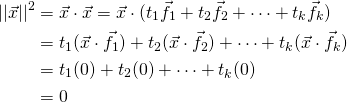
We saw in Section 4.2 that if and  are nonzero vectors in , then
 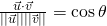 where
where  is the angle between and . Since
  for any angle , this shows that
  . In this form the result holds in .
Proof:
The inequality holds if or  (in fact it is equality). Otherwise, write
  and
and  for convenience. A computation like that preceding Example 5.3.2 gives
(5.1) 
It follows that  and
and  , and hence that
  . Hence
  , proving the Cauchy inequality.
If equality holds, then  , so
, so  or
or  . Hence Equation (5.1) shows that
  or
or  , so one of and is a multiple of the other (even if
  or
or  ).
).
There is an important consequence of the Cauchy inequality. Given and in , use Example 5.3.2 and the fact that  to compute

Taking positive square roots gives:
The reason for the name comes from the observation that in the inequality asserts that the sum of the lengths of two sides of a triangle is not less than the length of the third side.
Proof:
(1) and (2) restate part (5) of Theorem 5.3.1 because  , and (3) follows because
  for every vector in . To prove (4) use the Corollary to Theorem 5.3.2:

Orthogonal Sets and the Expansion Theorem
The standard basis is an orthonormal set in .
If , it follows from item (6) of Theorem 5.3.1 that  is a unit vector, that is it has length .
The most important result about orthogonality is Pythagoras' theorem. Given orthogonal vectors and in , it asserts that

. In this form the result holds for any orthogonal set in .
If is an orthogonal set in , then

Proof:
The fact that  whenever
  gives
gives

This is what we wanted.
If and are orthogonal, nonzero vectors in , then they are certainly not parallel, and so are linearly independent Example 5.2.7. The next theorem gives a far-reaching extension of this observation.
Every orthogonal set in is linearly independent.
Proof:
Let be an orthogonal set in and suppose a linear combination vanishes, say:  . Then
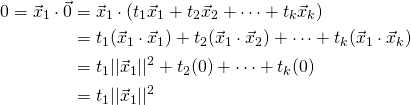
Since  , this implies that . Similarly for each .
Proof:
Since  spans , we have
  where the are scalars. To find
  we take the dot product of both sides with
  :
:
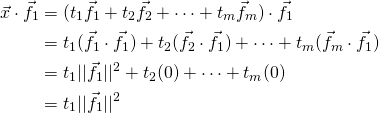
Since  , this gives
  . Similarly,
  for each .
The expansion in Theorem 5.3.6 of as a linear combination of the orthogonal basis is called the Fourier expansion of , and the coefficients  are called the Fourier coefficients. Note that if is actually orthonormal, then
  for each .
Solution:
We have  ,
,  ,
,  , and
, and  so the Fourier coefficients are

The reader can verify that indeed  .
.
In this section we use the concept of dimension to clarify the definition of the rank of a matrix given in Section 1.2, and to study its properties. This requires that we deal with rows and columns in the same way. While it has been the custom to write the -tuples as columns, in this section we will frequently write them as rows. Subspaces, independence, spanning, and dimension are defined for rows using matrix operations, just as for columns. If is an matrix, we define:
Proof:
We prove (1); the proof of (2) is analogous. It is enough to do it in the case when  by a single row operation. Let
  denote the rows of . The row operation either interchanges two rows, multiplies a row by a nonzero constant, or adds a multiple of a row to a different row. We leave the first two cases to the reader. In the last case, suppose that times row
  is added to row
  where
where  . Then the rows of are
  , and Theorem 5.1.1 shows that

That is,  .
.
If is any matrix, we can carry  by elementary row operations where is a row-echelon matrix. Hence
  by Lemma 5.4.1; so the first part of the following result is of interest.
Proof:
The rows of are independent, and they span  by definition. This proves (1).
Let  denote the columns of containing leading s. Then
  is independent because the leading s are in different rows (and have zeros below and to the left of them). Let denote the subspace of all columns in in which the last
  entries are zero. Then
  (it is just
  with extra zeros). Hence the independent set is a basis of by Theorem 5.2.7. Since each
  is in
is in  , it follows that
  , proving (2).
Let be any matrix and suppose is carried to some row-echelon matrix by row operations. Note that is not unique. In Section 1.2 we defined the rank of , denoted  , to be the number of leading s in , that is the number of nonzero rows of . The fact that this number does not depend on the choice of was not proved. However part 1 of Lemma 5.4.2 shows that

and hence that is independent of .
Lemma 5.4.2 can be used to find bases of subspaces of (written as rows). Here is an example.
Find a basis of  .
.
Solution:
is the row space of ![\left[ \begin{array}{rrrr} 1 & 1 & 2 & 3 \\ 2 & 4 & 1 & 0 \\ 1 & 5 & -4&-9 \end{array} \right]](https://ecampusontario.pressbooks.pub/app/uploads/quicklatex/quicklatex.com-7c23ade522772f1c14104c9f58dacfc4_l3.png "Rendered by QuickLaTeX.com") . This matrix has row-echelon form
. This matrix has row-echelon form ![\left[ \begin{array}{rrrr} 1 & 1 & 2 & 3 \\ 0 & 1 & -\frac{3}{2} & -3 \\ 0 & 0 & 0 & 0 \end{array} \right]](https://ecampusontario.pressbooks.pub/app/uploads/quicklatex/quicklatex.com-d2414e1b807c114a8baa24906065aa3b_l3.png "Rendered by QuickLaTeX.com") , so
, so  is basis of by Lemma 5.4.1.
Note that  is another basis that avoids fractions.
Proof:
We have by Lemma 5.4.1, so (1) follows from 5.4.2. Moreover,  for some invertible matrix . Now write
 ![A = \left[ \begin{array}{cccc} \vec{c}_1 & \vec{c}_2 & \dots & \vec{c}_n \end{array} \right]](https://ecampusontario.pressbooks.pub/app/uploads/quicklatex/quicklatex.com-e5dfaf6b371438bf339a6041138ea219_l3.png "Rendered by QuickLaTeX.com") where are the columns of . Then
where are the columns of . Then
![\begin{equation*} R = UA = U \left[ \begin{array}{cccc} \vec{c}_1 & \vec{c}_2 & \dots & \vec{c}_n \end{array} \right] = \left[ \begin{array}{cccc} U\vec{c}_1 & U\vec{c}_2 & \cdots & U\vec{c}_n \end{array} \right] \end{equation*}](https://ecampusontario.pressbooks.pub/app/uploads/quicklatex/quicklatex.com-5d17b388ac4093114526f260f03ad14e_l3.png "Rendered by QuickLaTeX.com")
Thus, in the notation of (2), the set  is a basis of by Lemma 5.4.2. So, to prove (2) and the fact that
  , it is enough to show that
  is a basis of
  . First,
  is linearly independent because is invertible (verify), so we show that, for each , column
  is a linear combination of the . But
  is column of , and so is a linear combination of the
  , say
, say  where each
  is a real number.
Since is invertible, it follows that
 and the proof is complete.
Solution:
The reduction of to row-echelon form is as follows:
![\begin{equation*} \left[ \begin{array}{rrrr} 1 & 2 & 2 & -1 \\ 3 & 6 & 5 & 0 \\ 1 & 2 & 1 & 2 \end{array} \right] \rightarrow \left[\begin{array}{rrrr} 1 & 2 & 2 & -1 \\ 0 & 0 & -1 & 3 \\ 0 & 0 & -1 & 3 \end{array} \right] \rightarrow \left[ \begin{array}{rrrr} 1 & 2 & 2 & -1 \\ 0 & 0 & -1 & 3 \\ 0 & 0 & 0 & 0 \end{array} \right] \end{equation*}](https://ecampusontario.pressbooks.pub/app/uploads/quicklatex/quicklatex.com-0f22102323f60ad0dfc847153dfa4256_l3.png "Rendered by QuickLaTeX.com")
Hence = 2, and ![\{ \left[ \begin{array}{cccc} 1 & 2 & 2 & -1 \end{array} \right], \left[ \begin{array}{cccc} 0 & 0 & 1 & -3 \end{array} \right] \}](https://ecampusontario.pressbooks.pub/app/uploads/quicklatex/quicklatex.com-134289e67fb1246fc721084a7f84cec3_l3.png "Rendered by QuickLaTeX.com")
is a basis of  by 5.4.2. Since the leading s are in columns 1 and 3 of the row-echelon matrix, Theorem 5.4.1 shows that columns 1 and 3 of are a basis
![\left\{ \left[ \begin{array}{r} 1\\ 3\\ 1 \end{array} \right], \left[ \begin{array}{r} 2\\ 5\\ 1 \end{array} \right] \right\}](https://ecampusontario.pressbooks.pub/app/uploads/quicklatex/quicklatex.com-b9c57ed7268dd006a012890e70ae51d1_l3.png "Rendered by QuickLaTeX.com") of .
of .
If is any matrix, then  .
.
If is an matrix, we have  and
and  . Hence Theorem 5.2.8 shows that
  and
and  . Thus Theorem 5.4.1 gives:
Proof:
Lemma 5.4.1 gives  . Using this and Corollary 5.4.1 we get

Proof:
For (1), write ![V = \left[ \vec{v}_{1}, \vec{v}_{2}, \dots, \vec{v}_{q}\right]](https://ecampusontario.pressbooks.pub/app/uploads/quicklatex/quicklatex.com-51cffdfd187297217a183679528dab2c_l3.png "Rendered by QuickLaTeX.com") where
where  is column of
  . Then we have
 ![AV = \left[ A\vec{v}_{1}, A\vec{v}_{2}, \dots, A\vec{v}_{q}\right]](https://ecampusontario.pressbooks.pub/app/uploads/quicklatex/quicklatex.com-eff8787c05a0a141eb4cd1f39280b255_l3.png "Rendered by QuickLaTeX.com") , and each
, and each  is in by Definition 2.4. It follows that
  . If
. If  , we obtain
 ![\func{col} A = \func{col}\left[ (AV)V^{\prime} \right] \subseteq \func{col}(AV)](https://ecampusontario.pressbooks.pub/app/uploads/quicklatex/quicklatex.com-0d7218655e1572eab40bc1a2c9b6e005_l3.png "Rendered by QuickLaTeX.com") in the same way. This proves (1).
in the same way. This proves (1).
As to (2), we have ![\func{col}\left[ (UA)^{T}\right] = \func{col}(A^{T}U^{T}) \subseteq \func{col}(A^{T})](https://ecampusontario.pressbooks.pub/app/uploads/quicklatex/quicklatex.com-5c8565e39f6549d09aa876a204343f48_l3.png "Rendered by QuickLaTeX.com") by (1), from which
by (1), from which  . If
. If  , this is equality as in the proof of (1).
Proof:
By Lemma 5.4.3  and
and  , so Theorem 5.4.1 applies.
In Section 5.1 we discussed two other subspaces associated with an matrix : the null space  and the image space

Using rank, there are simple ways to find bases of these spaces. If has rank , we have  by Example 5.1.8, so
 ![\func{dim}[\func{im}(A)] = \func{dim}[\func{col}(A)] = r](https://ecampusontario.pressbooks.pub/app/uploads/quicklatex/quicklatex.com-4da78097784d17f3ade3cd6954fa4d7f_l3.png "Rendered by QuickLaTeX.com") . Hence Theorem 5.4.1 provides a method of finding a basis of . This is recorded as part (2) of the following theorem.
. Hence Theorem 5.4.1 provides a method of finding a basis of . This is recorded as part (2) of the following theorem.
Proof:
It remains to prove (1). We already know (Theorem 2.2.1) that is spanned by the  basic solutions of . Hence using Theorem 5.2.7, it suffices to show that
 ![\func{dim}[\func{null}(A)] = n - r](https://ecampusontario.pressbooks.pub/app/uploads/quicklatex/quicklatex.com-934ff380db87a8bce53ba20304114be4_l3.png "Rendered by QuickLaTeX.com") . So let
. So let  be a basis of , and extend it to a basis
  of (by Theorem 5.2.6). It is enough to show that
  is a basis of ; then
  by the above and so
  as required.
Spanning. Choose in , in , and write  where the are in .
Then  because
  .
.
Independence. Let  , in . Then
  is in , so
  for some
  in . But then the independence of the shows that for every .
Solution:
If is in , then , so is given by solving the system . The reduction of the augmented matrix to reduced form is
![\begin{equation*} \left[ \begin{array}{rrrr|r} 1 & -2 & 1 & 1 & 0 \\ -1 & 2 & 0 & 1 & 0 \\ 2 & -4 & 1 & 0 & 0 \end{array} \right] \rightarrow \left[ \begin{array}{rrrr|r} 1 & -2 & 0 & -1 & 0 \\ 0 & 0 & 1 & 2 & 0 \\ 0 & 0 & 0 & 0 & 0 \end{array} \right] \end{equation*}](https://ecampusontario.pressbooks.pub/app/uploads/quicklatex/quicklatex.com-67521bba1336a37932693be3bf7ca9f2_l3.png "Rendered by QuickLaTeX.com")
Hence  . Here, has basis
![\left\{ \left[ \begin{array}{r} 1\\ -1\\ 2 \end{array} \right], \left[ \begin{array}{r} 1\\ 0\\ 1 \end{array} \right] \right\}](https://ecampusontario.pressbooks.pub/app/uploads/quicklatex/quicklatex.com-d5e447dbc4feb276346c2e0abcb3a200_l3.png "Rendered by QuickLaTeX.com") by Theorem 5.4.1 because the leading s are in columns 1 and 3. In particular,
by Theorem 5.4.1 because the leading s are in columns 1 and 3. In particular, ![\func{dim}[\func{im}(A)] = 2 = r](https://ecampusontario.pressbooks.pub/app/uploads/quicklatex/quicklatex.com-c9a20cff4fc2fa64300ffb36a2280660_l3.png "Rendered by QuickLaTeX.com") as in Theorem 5.4.2.
as in Theorem 5.4.2.
Turning to , we use gaussian elimination. The leading variables are  and
and  , so the nonleading variables become parameters:
  and
and  . It follows from the reduced matrix that
  and
and  , so the general solution is
![\begin{equation*} \vec{x} = \left[ \begin{array}{r} x_1\\ x_2\\ x_3\\ x_4 \end{array} \right] = \left[ \begin{array}{c} 2s + t\\ s\\ -2t\\ t \end{array} \right] = s\vec{x}_1 + t\vec{x}_2 \mbox{ where } \vec{x}_1 = \left[ \begin{array}{r} 2\\ 1\\ 0\\ 0 \end{array} \right], \mbox{ and } \vect{x}_2 = \left[ \begin{array}{r} 1\\ 0\\ -2\\ 1 \end{array} \right]. \end{equation*}](https://ecampusontario.pressbooks.pub/app/uploads/quicklatex/quicklatex.com-6f26bbdba1a023addc94962f0140dc4a_l3.png "Rendered by QuickLaTeX.com")
Hence . But and  are solutions (basic), so

However Theorem 5.4.2 asserts that  is a basis of . (In fact it is easy to verify directly that is independent in this case.) In particular,
 ![\func{dim}[\func{null}(A)] = 2 = n - r](https://ecampusontario.pressbooks.pub/app/uploads/quicklatex/quicklatex.com-d3c493d03179fce6028d5dd3c96864f5_l3.png "Rendered by QuickLaTeX.com") .
.
Let be an matrix. Corollary 5.4.2 asserts that  and
and  , and it is natural to ask when these extreme cases arise. If are the columns of , Theorem 5.2.2 shows that spans if and only if the system is consistent for every in , and that is independent if and only if , in , implies . The next two useful theorems improve on both these results, and relate them to when the rank of is or .
Proof:
(1)  (2). We have , and
  by (1), so
  by Theorem 5.2.8. This is (2).
(2) (3). By (2), , so  . This means
  . Since the columns of span , they are independent by Theorem 5.2.7.
(3) (4). If  , in , we show that (Theorem 2.4.5). We have

Hence , so by (3) and Theorem 5.2.2.
(4) (5). Given (4), take  .
.
(5) (6). If , then left multiplication by  (from (5)) gives .
(6) (1). Given (6), the columns of are independent by Theorem 5.2.2. Hence , and (1) follows.
Proof:
(1) (2). By (1),  , so
, so  by Theorem 5.2.8.
(2) (3). By (2), , so  . This means
  . Since the rows of span , they are independent by Theorem 5.2.7.
(3) (4). We have by (3), so the  matrix has rank . Hence applying Theorem 5.4.3 to in place of shows that
  is invertible, proving (4).
(4) (5). Given (4), take  in (5).
(5) (6). Comparing columns in  gives
gives  for each , where and denote column of and
  respectively. Given in , write
 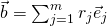 ,
,  in . Then holds with
 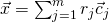 as the reader can verify.
(6) (1). Given (6), the columns of span by Theorem 5.2.2. Thus and (1) follows.
Similar Matrices
Note that  if and only if
  where
where  is invertible (write
  ). The language of similarity is used throughout linear algebra. For example, a matrix is diagonalizable if and only if it is similar to a diagonal matrix.
If , then necessarily  . To see why, suppose that
  . Then
  where
where  is invertible. This proves the second of the following properties of similarity:
(5.2) 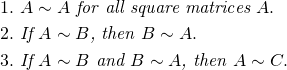
These properties are often expressed by saying that the similarity relation  is an equivalence relation on the set of matrices. Here is an example showing how these properties are used.
Solution:
We have . Suppose that is diagonalizable, say  where is diagonal. Since by (2) of (5.2), we have and . Hence
  by (3) of (5.2), so is diagonalizable too. An analogous argument works if we assume instead that is diagonalizable.
Similarity is compatible with inverses, transposes, and powers:

In other words:
![\begin{equation*} \mbox{If } A = \left[ a_{ij}\right],\mbox{ then } \func{tr } A = a_{11} + a_{22} + \dots + a_{nn}. \end{equation*}](https://ecampusontario.pressbooks.pub/app/uploads/quicklatex/quicklatex.com-0decaf2c946100f191ed5c1c68bfcad4_l3.png "Rendered by QuickLaTeX.com")
It is evident that  and that
  holds for all matrices and and all scalars . The following fact is more surprising.
Proof:
Write ![A = \left[ a_{ij} \right]](https://ecampusontario.pressbooks.pub/app/uploads/quicklatex/quicklatex.com-4e31c1ef0ac00a4b1f249f3c262ac4be_l3.png "Rendered by QuickLaTeX.com") and
and ![B = \left b_{ij} \right]](https://ecampusontario.pressbooks.pub/app/uploads/quicklatex/quicklatex.com-c16f57142386a0c4b9fb25ee74351aca_l3.png "Rendered by QuickLaTeX.com") . For each , the
. For each , the  -entry
  of the matrix
  is given as follows:
  . Hence

Similarly we have  . Since these two double sums are the same, Lemma 5.5.1 is proved.
Proof:
Let for some invertible matrix . Then we have

Similarly,  by Corollary 5.4.2. Next Lemma 5.5.1 gives
![\begin{equation*} \func{tr} (P^{-1}AP) = \func{tr}\left[ P^{-1}(AP)\right] = \func{tr}\left[ (AP)P^{-1}\right] = \func{tr } A \end{equation*}](https://ecampusontario.pressbooks.pub/app/uploads/quicklatex/quicklatex.com-4d8821f2a6d91e34271fdc386407ec74_l3.png "Rendered by QuickLaTeX.com")
As to the characteristic polynomial,
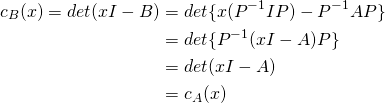
Finally, this shows that and have the same eigenvalues because the eigenvalues of a matrix are the roots of its characteristic polynomial.
Diagonalization Revisited
Recall that a square matrix is diagonalizable if there exists an invertible matrix such that  is a diagonal matrix, that is if is similar to a diagonal matrix \index{diagonal matrices}. Unfortunately, not all matrices are diagonalizable, for example
 ![\left[ \begin{array}{rr} 1 & 1 \\ 0 & 1 \end{array} \right]](https://ecampusontario.pressbooks.pub/app/uploads/quicklatex/quicklatex.com-4fbd276d5bb44c59c46b49aaeeab16cd_l3.png "Rendered by QuickLaTeX.com") . Determining whether is diagonalizable is closely related to the eigenvalues and eigenvectors of . Recall that a number is called an eigenvalue of if
. Determining whether is diagonalizable is closely related to the eigenvalues and eigenvectors of . Recall that a number is called an eigenvalue of if  for some nonzero column in , and any such nonzero vector is called an eigenvector of corresponding to (or simply a -eigenvector of ). The eigenvalues and eigenvectors of are closely related to the characteristic polynomial
 of , defined by

If is this is a polynomial of degree , and its relationship to the eigenvalues is given in the following theorem.
The next theorem will show us the condition when a square matrix is diagonalizable.
The next result is a basic tool for determining when a matrix is diagonalizable. It reveals an important connection between eigenvalues and linear independence: Eigenvectors corresponding to distinct eigenvalues are necessarily linearly independent.
Show that ![A = \left[ \begin{array}{rrr} 1 & 0 & 0 \\ 1 & 2 & 3 \\ -1 & 1 & 0 \\ \end{array} \right]](https://ecampusontario.pressbooks.pub/app/uploads/quicklatex/quicklatex.com-a35a58a60e4e2c345594b69b9f9fb2a8_l3.png "Rendered by QuickLaTeX.com") is diagonalizable.
is diagonalizable.
Solution:
A routine computation shows that  and so has distinct eigenvalues , , and
  . Hence Theorem 5.5.5 applies.
This is a subspace of and the eigenvectors corresponding to are just the nonzero vectors in  . In fact is the null space of the matrix
  :
:

The basic solutions of the homogeneous system given by the gaussian algorithm form a basis for . In particular
(5.5) 
Now recall that the multiplicity of an eigenvalue of is the number of times occurs as a root of the characteristic polynomial of . In other words, the multiplicity of is the largest integer  such that

for some polynomial  . Because of (5.5), a square matrix is diagonalizable if and only if the multiplicity of each eigenvalue equals
 ![\func{dim}\left[ E_{\lambda}(A)\right]](https://ecampusontario.pressbooks.pub/app/uploads/quicklatex/quicklatex.com-c03ebdd697e52b6ad5c2dd70b40da360_l3.png "Rendered by QuickLaTeX.com") . We are going to prove this, and the proof requires the following result which is valid for any square matrix, diagonalizable or not.
. We are going to prove this, and the proof requires the following result which is valid for any square matrix, diagonalizable or not.
It turns out that this characterizes the diagonalizable matrices for which factors completely over . By this we mean that  , where the
  are real numbers (not necessarily distinct); in other words, every eigenvalue of is real. This need not happen (consider
 ![A = \left[ \begin{array}{rr} 0 & -1 \\ 1 & 0 \end{array} \right]](https://ecampusontario.pressbooks.pub/app/uploads/quicklatex/quicklatex.com-c496a7cecb28e70841650cb0a582bf87_l3.png "Rendered by QuickLaTeX.com") ), which leads us to the general conclusion regarding when a square matrix is diagonalizable.
), which leads us to the general conclusion regarding when a square matrix is diagonalizable.
Solution:
We have  so the eigenvalues are
  and
and  . The corresponding eigenspaces are
  and
and  where
where
![\begin{equation*} \vec{x}_1 = \left[ \begin{array}{r} -1\\ 1\\ 0 \end{array} \right], \vec{x}_2 = \left[ \begin{array}{r} -2\\ 0\\ 1 \end{array} \right] , \vec{x}_3 = \leftB[ \begin{array}{r} 2\\ 1\\ -1 \end{array} \right] \end{equation*}](https://ecampusontario.pressbooks.pub/app/uploads/quicklatex/quicklatex.com-dc7fce8032b16436066f204e3a06b5a6_l3.png "Rendered by QuickLaTeX.com")
as the reader can verify. Since is independent, we have  which is the multiplicity of
  . Similarly,
  equals the multiplicity of
  . Hence is diagonalizable
by 5.5.6, and a diagonalizing matrix is ![P = \left[ \begin{array}{ccc} \vec{x}_{1} & \vec{x}_{2} & \vec{x}_{3} \end{array} \right]](https://ecampusontario.pressbooks.pub/app/uploads/quicklatex/quicklatex.com-9a571c6a267de83e3084f028423ebfeb_l3.png "Rendered by QuickLaTeX.com") .
.
Turning to ,  so the eigenvalues are
  and
and  . The corresponding eigenspaces are
  and
and  where
where
![\begin{equation*} \vec{y}_1 = \left[ \begin{array}{r} -1\\ 2\\ 1 \end{array} \right], \vec{y}_2 =\left[ \begin{array}{r} 5\\ 6\\ -1 \end{array} \right] \end{equation*}](https://ecampusontario.pressbooks.pub/app/uploads/quicklatex/quicklatex.com-3b36136b20ca2eba553e156dfb2039f8_l3.png "Rendered by QuickLaTeX.com")
Here  is smaller than the multiplicity of , so the matrix is not diagonalizable, again by Theorem 5.5.6. The fact that means that there is no possibility of finding three linearly independent eigenvectors.
Source: https://ecampusontario.pressbooks.pub/linearalgebrautm/chapter/vector-space-mathbbrn/
0 Response to "Suppose Cr11 is the Vector Space of Continuous Realvalued Functions Show That U Perp 0"
Post a Comment